Re400F/K 4K60 Standard KVM Input Node
- characteristics
- parameters
- download
Adopts Linux-based distributed architecture design with decentralized structure; any number of nodes can be expanded without servers or master control nodes; each node is independent and does not interfere with others, reducing system operation risk and maintenance costs;
Video input: supports RTSP and RTMP protocols and proprietary protocols; 2 HDMI inputs with embedded audio sync or async input; supports 1 encoding channel and 1 HDMI loop output;
Supports HDMI, DVI, VGA and other signals; input resolution supports up to 3840*2160@60Hz, backward compatible, with adaptive input resolution.
Supports remote KVM control; the operator position can remotely control server-room computers including power on/off; up to 16 windows of different signal sources can be controlled simultaneously, with manual and automatic control modes.
2. Fanless silent design; supports independent installation in a 1U cabinet or side-by-side installation of 2 units;
3. Each node unit uses an H.265 stream codec chip with backward compatibility, ensuring smooth system operation;
4. Video input: supports RTSP and RTMP protocols and proprietary protocols; 2 HDMI inputs with embedded audio sync or async input; supports port backup; supports 1 encoding channel and 1 HDMI loop output;
5. Audio input: supports AAC, G.711, G.726 and proprietary protocols, supports CBR/VBR, adjustable frame rate 1-60fps, audio input interface with embedded audio sync or async input, supports volume adjustment, and supports three modes of synchronous, asynchronous and mixing; supports multi-channel audio mixing playback with lossless sound quality;
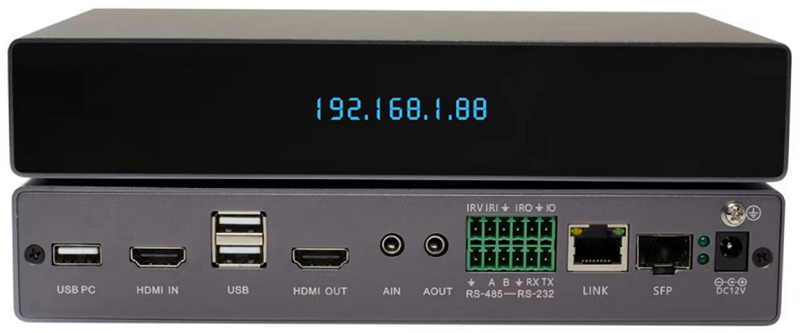
6. With 1 factory reset button, 3 USB 2.0 ports, 1 gigabit network port, 1 gigabit optical port, 2 HDMI video input/output interfaces, 2 3.5mm audio input/output interfaces, 1 RS232 interface, 1 RS485 interface, and 3 IR/IO.
7. Each node has >= 3 USB interfaces for connecting to computers; KVM function can be achieved without additional hardware;
8. Supports HDMI, DVI, VGA and other signals; input resolution supports up to 3840x2160@60Hz, backward compatible,
9. Supports constant bitrate transmission, adjustable range 128kbps~40Mbps;
10. Supports unicast and multicast;
11. Supports H.264 and H.265 IPC-encoded cameras; IPC network camera signals can be connected and output directly to the large screen without a third-party transcoding server; supports PTZ zoom in/out and left-right rotation.
12. Supports operator-position pushing to large screen; any video source in the list can be pushed via the local operator position to the local or remote splicing large screen for full-screen display, with windowing, roaming, overlay, painting, etc.; real-time preview of signal sources and virtual screens;
13. Large-screen windowing supports regular windowing such as 2x2 and 3x3, as well as irregular windowing by freely splitting window layouts via manual dragging;
14. Supports operator-position video/voice intercom and text chat; operators can communicate one-on-one via video, voice and text; supports broadcasting among operator positions, one-to-many speaking, and operator-position speech to the entire hall environment;
15. Supports multi-party meeting mode, with >= 16 operators entering the meeting interface simultaneously and 16-channel mixing; participants can be added or removed at any time during the meeting.
16. Supports operator-position pre-operation mode; layout can be done in the virtual screen area without real-time display on the large screen; clicking the push button puts the adjusted layout on screen with one key, preventing misoperation;
17. Supports remote KVM control; the operator position can remotely control server-room computers including power on/off; up to 16 windows of different signal sources can be controlled simultaneously; with manual and automatic control modes;
18. Supports mutual signal request and push between operator positions; supports three-level permission management;; supports signal capture from the large screen; supports large screen zoning management; supports saving and recalling of plans for operator positions and the large screen;
19. Supports multiple login methods (account password, fingerprint, face recognition), with seat memory function; operators are not limited to the current seat; logging in at any seat retains the original layout without re-arranging.
20. Supports operator-position message queue notifications; reminders of signal on/off line and delivery of other messages;
21. Supports OSD top and bottom menu bars; all work such as pushing to screen, pushing to operator position, takeover, control, request and visual intercom can be done with the mouse only, with a computer-like operation experience; shortcut key operation is also supported;
22. System scenes provide one-key recovery; node devices have programmable storage capability, automatically restoring the system to the pre-power-off state after power failure restart, such as volume, large screen on/off, signal position, lighting environment, etc.;
23. Supports operator-position local viewing of node status; without other software, users can view the version information of their own node, device IP, server IP, CPU and memory usage, network speed, running time, etc.
24. Supports distinguishing channel status modes by channel frame color, including takeover, control, receiving, no signal and other frame colors; each frame type has no less than 11 color options; supports changing the width of the signal frame, up to 3px. Frames can also be hidden.
25. Supports setting the position and size of the floating ball of each signal channel; position options include low, medium and high, and size options include large, medium and small, settable according to operator habits.
26. Supports OSD overlay display of device name, time, station logo, etc.; supports dual station logos with editable logo text;
27. Supports one-key screen synchronization; a laid-out scene or picture can be synchronized to other display screens with one key, showing the same picture
28. Supports tablet and operator-position linkage; any signal source can be pushed to the operator position via the tablet for linked operation
29. Supports banner function; clock, duty schedule and other information can be displayed on both sides of the large screen for staff query and rotation.
30. Supports button linkage function; one button can control multiple buttons for box control and network control
31. Audio-to-wall function; audio can be put on the large screen separately via the magic software
32. Signal prohibition on screen; the magic software prohibit button can prevent a signal from being displayed on screen after clicking, to avoid misoperation
33. Annotation function; the large screen can be annotated in the software with arrows, symbols, ellipses, squares, text, etc., synchronized to the large screen with one key.
34. Supports node LCD status display, showing node name, IP address, running status, etc.
35. Nodes support synchronous encoding and decoding; the operator output node can also support signal source capture while outputting at the operator end
36. Supports EDID extended display identification auto-recognition, supports HDCP;
37. Supports dual power supply modes of POE and external power;
38. Supports upgrading encoding devices via the network;
39. Supports optical network hot backup
40. Device power consumption <= 10W;
41. Operating temperature -10°C~60°C, operating humidity 10%~90% non-condensing.