
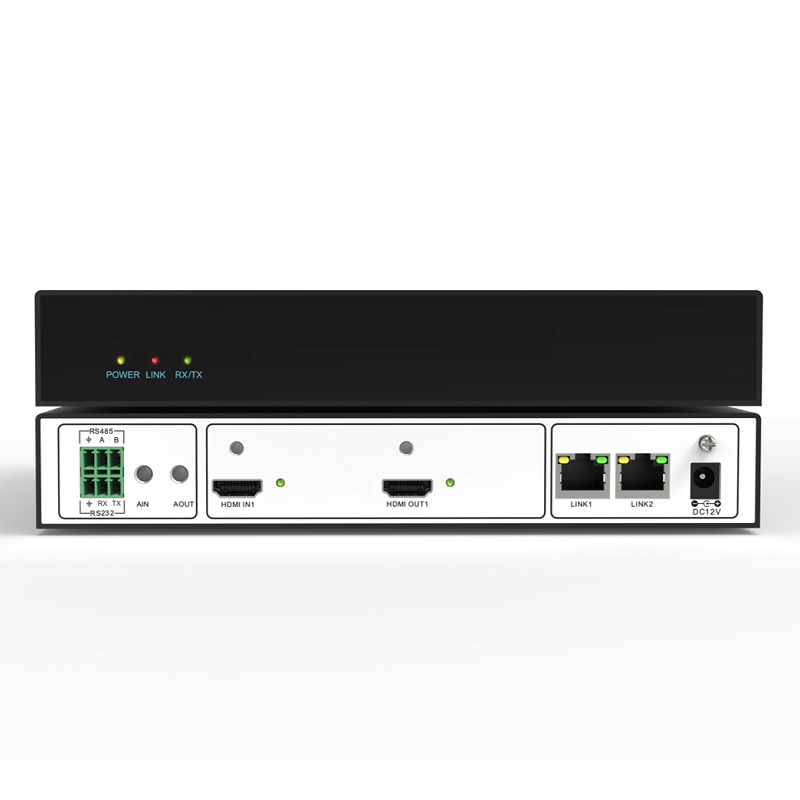
Re200C 2K Splicing Output Node
The visualized distributed system is mainly used in large places such as command centers, monitoring centers and exhibition halls. It can gather audio-visual information distributed in different locations on a large screen, and realize interconnection of audio-visual data among multiple venues. One system can achieve many advantageous functions such as visualized management, audio-visual matrix, large screen splicing, LAN video conference, KVM operator-position collaboration, and conference recording.
- characteristics
- parameters
- download
Adopts Linux-based distributed architecture design with decentralized structure; any number of nodes can be expanded without servers or master control nodes; each node is independent and does not interfere with others, reducing system operation risk and maintenance costs;
Video input: supports RTSP and RTMP protocols and proprietary protocols; 2 HDMI inputs with embedded audio sync or async input; supports 1 encoding channel and 1 HDMI loop output;
Supports HDMI, DVI, VGA and other signals; input resolution supports up to 1920*1080@60Hz, backward compatible, with adaptive input resolution.
1.Adopts Linux-based distributed architecture design with decentralized structure; any number of nodes can be expanded without servers or master control nodes; each node is independent and does not interfere with others, reducing system operation risk and maintenance costs;
2. Fanless silent design; supports independent installation in a 1U cabinet or side-by-side installation of 2 units;
3. Each node unit uses an H.264 stream codec chip with backward compatibility, ensuring smooth system operation;
4. Video output: supports RTSP and RTMP protocols and proprietary protocols; 2 HDMI outputs with embedded audio sync or async output; supports 1 decoding channel;
5. Audio output: supports AAC, G.711, G.726 and proprietary protocols, supports CBR/VBR, adjustable frame rate 1-60fps, audio input interface with embedded audio sync or async input, supports volume adjustment, and supports three modes of synchronous, asynchronous and mixing; supports multi-channel audio mixing playback with lossless sound quality;
6. Supports audio visualization management by module; the output volume of each node can be controlled with sliders, and audio energy bars can be displayed, showing the audio status of nodes with animation effects
7. With 1 power indicator light, 1 video signal indicator light, 1 network status and signal transmission status light, 1 factory reset button, 2 gigabit network ports, 2 HDMI video input/output interfaces, 2 3.5mm audio input/output interfaces, 1 RS232 interface, and 1 RS485 interface.
8. Output signal resolution supports up to 1920x1080@60Hz, backward compatible, with adaptive output signal resolution;
9. Supports LED, DID, LCD and DLP splicing, roaming, dragging, custom splitting and multi-layer overlay display; a single screen supports 4 channels of video display and overlay simultaneously; standard resolution output for seamless splicing;
10. Supports constant bitrate transmission, adjustable range 128kbps~40Mbps;
11. Supports unicast and multicast;
12. Supports H.264 and H.265 IPC-encoded cameras; IPC network camera signals can be connected and output directly to the large screen without a third-party transcoding server; supports PTZ zoom in/out and left-right rotation.
13. System scenes provide one-key recovery; node devices have programmable storage capability, automatically restoring the system to the pre-power-off state after power failure restart, such as volume, large screen on/off, signal position, lighting environment, etc.;
14. Supports classification, grouping and sorting of signal sources, with three-level group management for all signal sources displayed in tree form, sortable by name, IP or custom criteria; the client software supports no less than 50 channels of real-time dynamic image preview..
15. Supports OSD overlay display of device name, time, station logo, etc.; supports dual station logos with editable logo text;
16. Supports the environment control module; lights, curtains and other environment devices can be controlled directly via RS232/RS485 serial ports without central control equipment.
17. Supports OSD subtitle overlay and HD background image;
18. Supports EDID extended display identification auto-recognition, supports HDCP;
19. Supports dual power supply modes of POE and external power;
20. Supports upgrading encoding devices via the network;
21. Device power consumption <= 10W;
22. Operating temperature -10°C~60°C, operating humidity 10%~90% non-condensing.
Prev:Tr200C 2K Conference Edition Input Node
Next:nothing…